
The advantages of playing video games extend far beyond entertainment. Depending on the type of game and how often someone plays, gaming may help develop cognitive abilities, improve problem-solving skills, strengthen social connections, and support emotional well-being. Although excessive gaming can have drawbacks, playing in moderation may offer meaningful benefits for children, teenagers, and adults.
The Advantages of Playing Video Games include challenging players to think strategically, respond to changing situations, solve problems, and collaborate with others. Different genres offer different opportunities to develop these abilities, from solving puzzles and managing simulations to participating in competitive multiplayer adventures.
In this article, we explore 10 potential advantages of playing video games, including their effects on cognitive development, creativity, coordination, learning, and social interaction.
Key Takeaways
- Cognitive development: Certain games may improve attention, memory, reasoning, and information processing.
- Problem-solving: Strategy and puzzle games encourage logical thinking, critical analysis, and decision-making.
- Hand-eye coordination: Action and rhythm games can help develop visual-motor coordination.
- Creativity: Sandbox and construction games encourage imagination, experimentation, and design.
- Social connections: Multiplayer games create opportunities to practice teamwork, communication, and cooperation.
- Emotional well-being: Gaming may provide relaxation, enjoyment, and a sense of accomplishment.
- Learning: Educational games can make academic subjects more interactive and engaging.
- Persistence: Challenging gameplay encourages players to learn from mistakes and try different approaches.
- Spatial awareness: Certain games help players visualize objects, navigate environments, and interpret maps.
- Digital literacy: Gaming can introduce transferable skills related to technology, collaboration, and strategic planning.
1. Cognitive Development and Mental Agility
One of the potential advantages of playing video games is improved cognitive performance. Cognitive skills include attention, memory, reasoning, information processing, and the ability to understand and respond to new information.
Many of the Advantages of Playing Video Games come from their ability to require players to process several types of information simultaneously. For example, an action game may challenge players to track opponents, monitor environmental changes, remember objectives, and react quickly to unexpected situations.
Research on action video games has associated certain types of gameplay with improvements in visual attention and information processing. Players may become more efficient at identifying relevant details and responding to visual information.
Other genres provide different types of cognitive challenges. Puzzle and strategy games encourage players to recognize patterns, remember important information, plan ahead, and evaluate possible outcomes.
Practical examples: Games such as Tetris, Portal, and strategy titles encourage pattern recognition, mental visualization, and decision-making in changing situations.
However, improvements in specific cognitive skills do not necessarily transfer to every everyday activity. The results depend on the type of game, the abilities being practiced, and the amount of time spent playing.
2. Better Problem-Solving and Critical Thinking
Video games frequently challenge players to overcome obstacles through careful thinking rather than random actions. Players must understand a situation, identify available resources, consider different approaches, and choose effective solutions.
Strategy games are particularly useful for practicing these skills. Players may need to manage resources, anticipate opponents’ actions, establish priorities, and adjust their plans when circumstances change.
Puzzle and adventure games also encourage analytical thinking. Progress often depends on connecting clues, recognizing relationships, and experimenting with different solutions.
These experiences can reinforce a methodical approach to challenging tasks, encouraging players to consider their options before making decisions.
For example, managing a virtual city requires players to balance resources, infrastructure, population needs, and economic development. Each decision can affect several interconnected systems, creating opportunities to practice planning and understand the consequences of different choices.
The problem-solving value of gaming is especially apparent in titles that reward thoughtful decisions, strategic thinking, and long-term planning.
3. Improved Hand-Eye Coordination and Motor Skills
Another potential benefit of playing video games is improved hand-eye coordination. Many games require players to connect visual information with precise physical movements, providing repeated opportunities to practice certain motor skills.
Action games, sports simulations, and rhythm games often involve accurate timing and controlled movements. Players must observe what happens on the screen and respond using a controller, keyboard, mouse, or touchscreen.
For example, racing games require players to monitor their position, anticipate turns, and adjust their steering. Rhythm games also demonstrate the Advantages of Playing Video Games by challenging players to coordinate their movements with changing visual and auditory cues.
Research has associated some of the Advantages of Playing Video Games with improvements in visual-motor coordination and particular aspects of spatial attention.
These abilities are among the practical Advantages of Playing Video Games, as they may have applications in activities requiring accurate visual guidance and coordinated movements. Specialized video game training programs have also been explored in medical education, particularly for practicing aspects of surgical coordination.
However, playing video games does not automatically improve every physical ability. Outcomes depend on the activities involved and how closely the movements practiced during gameplay resemble the skills being trained.
4. Increased Creativity and Imagination
Video games can also encourage creativity, particularly when they allow players to build, customize, experiment, and develop their own ideas.
Sandbox games are especially suited to creative exploration. They provide open-ended environments where players can construct buildings, design landscapes, create characters, and develop their own challenges.
Unlike games with strictly defined objectives, these experiences give players considerable freedom to decide what they want to create and how they want to accomplish their goals.
For example, Minecraft encourages players to design structures, experiment with materials, and build imaginative environments. Some players use the game to recreate real-world landmarks or construct complex mechanical systems.

Role-playing games provide another opportunity for creative thinking. Players can develop characters, explore fictional worlds, and make decisions that influence the direction of a story.
These activities allow players to experiment without facing the consequences associated with real-world mistakes. They can explore different ideas, test designs, and modify their creations as often as they like.
Parents and educators can encourage creativity through construction games, creative challenges, and collaborative world-building activities.
5. Stronger Social Connections and Communication Skills
Although video games are sometimes associated with social isolation, many modern games offer highly interactive social experiences.
Online multiplayer games allow people to communicate, cooperate, and compete with others regardless of their physical location. Team-based games frequently require players to coordinate strategies, exchange information, assign responsibilities, and adapt to changing situations.
These interactions provide opportunities to practice several valuable interpersonal skills, including:
- Communication: Sharing information clearly and responding to teammates.
- Teamwork: Cooperating with others to achieve shared objectives.
- Leadership: Organizing group activities and helping coordinate decisions.
- Conflict resolution: Addressing disagreements and finding ways to work together.
For example, a multiplayer team competing in an objective-based game must understand each member’s role and coordinate its actions to achieve a common goal.
Among the Advantages of Playing Video Games is the opportunity to build friendships around shared interests. Players may connect through online communities, tournaments, discussion groups, and gaming events.
However, not every online gaming environment provides a positive social experience. Harassment, toxic communication, and excessive competitiveness can negatively affect interactions. Choosing supportive communities and maintaining respectful communication are important for enjoying the social Advantages of Playing Video Games.
6. Stress Relief and Emotional Well-Being
One of the Advantages of Playing Video Games is that they can provide an enjoyable way to relax and temporarily disconnect from everyday responsibilities.
After a demanding day, some people turn to gaming as a leisure activity that helps them unwind. Engaging gameplay can offer entertainment, positive emotions, and a sense of accomplishment.
Different genres provide different experiences:
- Relaxing simulation games offer peaceful environments and activities.
- Adventure games provide opportunities for exploration and excitement.
- Cooperative games allow players to enjoy shared experiences with friends.
Research has explored the relationship between video games, mood, and psychological well-being. Findings suggest that gaming’s effects depend on the individual, the game, and the circumstances surrounding gameplay.
Completing a challenging level, for example, may create feelings of satisfaction and confidence. Playing with friends can also provide enjoyable social interaction.
Gaming may offer a sense of control and achievement, particularly when players work toward clear objectives and can see measurable progress.
However, video games should not become the only way to manage stress or difficult emotions. Sleep, exercise, social relationships, and other healthy activities remain essential for overall well-being.
Moderate gaming is more likely to support emotional well-being when it complements these activities rather than replacing them.
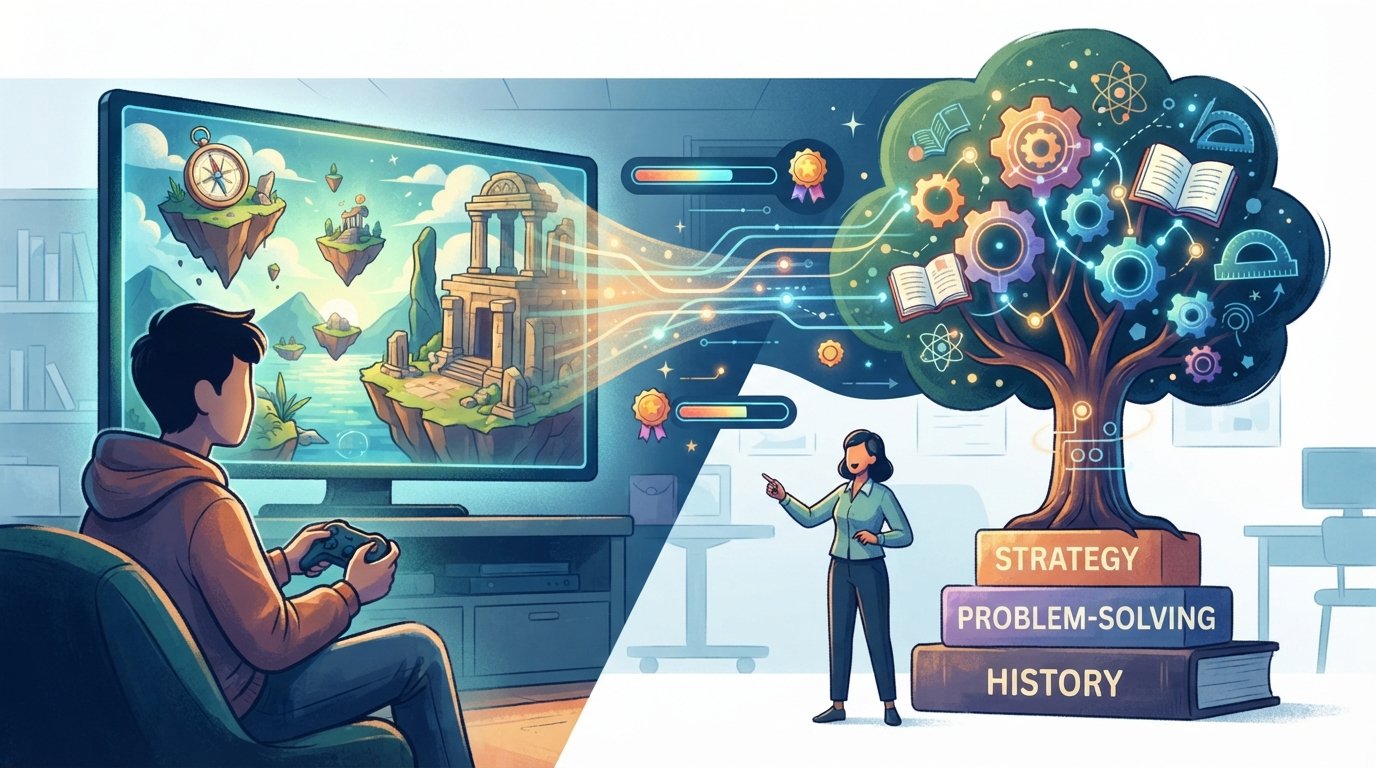
7. Educational Benefits and Improved Learning
Video games can make learning more interactive by turning information into practical challenges and activities.
Traditional learning methods often involve reading, listening, and memorization. Educational games introduce opportunities to apply knowledge, receive immediate feedback, and learn through experimentation.
Different types of educational games can support different subjects:
- Mathematics games: Help students practice calculations and numerical reasoning.
- Language-learning games: Introduce vocabulary and encourage repeated practice.
- History-based games: Expose players to historical settings, cultures, and events.
- Science simulations: Demonstrate concepts that might otherwise be difficult to understand through textbooks alone.
One important advantage of educational gaming is immediate feedback. When players make mistakes, many educational games explain the outcome or allow them to try again. This encourages repeated practice and gradual improvement.
Some educational games also increase motivation through points, challenges, rewards, and progress tracking.
Nevertheless, the Advantages of Playing Video Games do not mean entertainment games should automatically be considered educational. Their learning value depends on their content, design, and connection to specific educational objectives.

Teachers and parents can make the Advantages of Playing Video Games more effective as a learning activity by discussing what players discover and connecting virtual experiences with real-world knowledge.
8. Greater Patience, Persistence, and Resilience
Among the Advantages of Playing Video Games is the opportunity to develop persistence through repeated challenges before achieving success. A difficult level, powerful opponent, or complicated puzzle may take several attempts to complete.
Players must recognize mistakes, adjust their strategies, and continue working toward their objectives. This process can encourage persistence and resilience.
Rather than giving up after an unsuccessful attempt, players have opportunities to examine what went wrong and experiment with alternative approaches.
For example, someone attempting a difficult platforming challenge might gradually improve by studying enemy movements, learning the timing of obstacles, and refining their controls.
Games that gradually increase in difficulty can also help players become more comfortable with manageable challenges.
These experiences may reinforce a growth-oriented approach to learning: skills can improve through practice, feedback, and effort.
However, gaming does not automatically develop patience. Some games may encourage frustration or unhealthy competitiveness. The most useful experiences are generally those that reward learning, improvement, and thoughtful persistence rather than simply demanding endless repetition.
9. Enhanced Spatial Awareness and Navigation Skills
Spatial awareness is the ability to understand the position, distance, direction, and movement of objects within an environment.
Many video games require players to interpret maps, navigate unfamiliar locations, visualize three-dimensional spaces, and understand how different objects relate to one another.
For example, action games often require players to track moving objects and recognize changes in their surroundings. Simulation and building games encourage players to think about dimensions, positioning, distance, and structural relationships.
Players exploring large virtual environments may also need to remember landmarks, identify routes, and understand how different locations connect.
Research has suggested that certain types of video game experience, particularly action gaming, may improve aspects of spatial cognition.
These abilities are relevant to various everyday activities, including:
- Reading and interpreting maps.
- Navigating unfamiliar locations.
- Understanding diagrams and visual instructions.
- Mentally visualizing objects and their dimensions.
However, the Advantages of Playing Video Games vary because different games exercise different spatial abilities. A simple mobile puzzle game, for instance, provides a different experience from a complex three-dimensional exploration game.
10. Development of Digital Literacy and Transferable Skills
One of the Advantages of Playing Video Games is that they can introduce players to digital environments and technologies that are increasingly important in modern society.
The Advantages of Playing Video Games also include opportunities to become familiar with digital technology. Players regularly interact with menus, settings, online platforms, digital communication systems, and virtual economies. These experiences can help them become more comfortable navigating digital tools and environments.
Some games also introduce transferable skills through their mechanics and communities:
- Resource management: Simulation games encourage players to organize and allocate resources.
- Collaboration: Multiplayer games involve working with others toward shared goals.
- Strategic planning: Many games require players to evaluate options and plan ahead.
- Design and creativity: Creative games introduce concepts related to architecture, design, logic, and programming.
Beyond individual games, gaming communities have created opportunities for people to explore careers in game development, graphic design, animation, software engineering, esports, and digital content creation.
Playing video games alone does not provide professional qualifications or guarantee career opportunities. However, gaming can spark curiosity about these fields and motivate people to develop relevant skills.
Parents and educators can build on this interest by introducing coding activities, game design projects, and other practical technology-based learning opportunities.
How to Maximize the Benefits of Playing Video Games
Although video games can offer meaningful benefits, the way people play matters. Developing balanced gaming habits can help players enjoy these potential advantages without allowing gaming to interfere with other responsibilities.
Here are seven practical ways to make gaming a more positive and productive activity:
- Choose games with meaningful challenges. Puzzle, strategy, simulation, educational, and creative games provide different opportunities to practice useful skills. Select titles that encourage learning, exploration, and thoughtful decision-making.
-
Establish reasonable gaming time limits. Make sure gaming leaves enough time for sleep, school, work, exercise, and social activities. Balance is essential for maintaining a healthy routine.
-
Explore different gaming genres. Trying various types of games exposes players to different challenges and experiences. Switching between genres can provide opportunities to practice a wider range of skills.
-
Play with others when appropriate. Cooperative games can encourage communication, teamwork, and social interaction. Playing with friends or family can also make gaming a shared leisure activity.
-
Reflect on what you learn. Think about the strategies, skills, and problem-solving techniques used during gameplay. Consider whether any of these approaches can be applied to everyday situations.
-
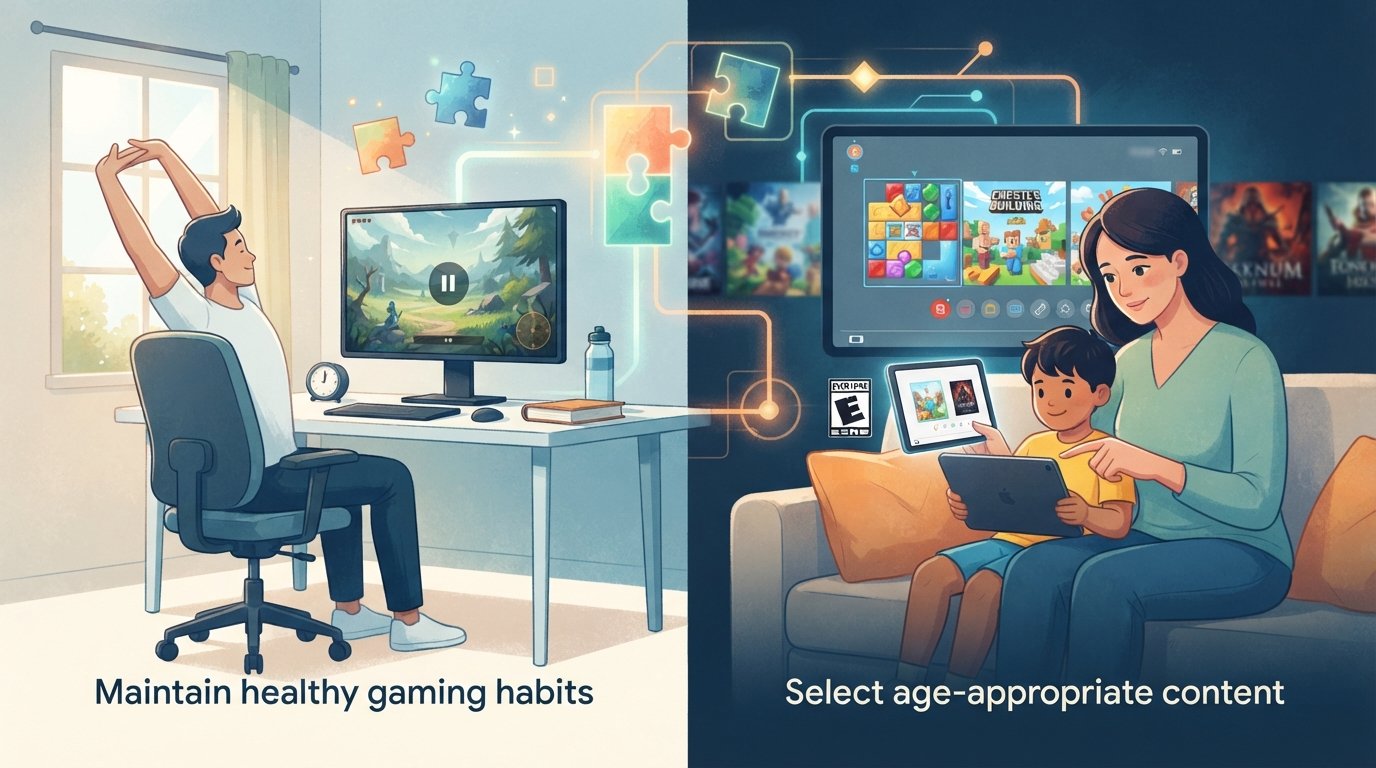
Maintain healthy gaming habits. Take regular breaks, maintain good posture, and avoid gaming at the expense of sleep or physical activity.
-
Select age-appropriate content. Parents should consider game ratings, online interactions, and individual players’ maturity levels when choosing games for children.
Ultimately, the Advantages of Playing Video Games are greatest when they form part of a varied and healthy lifestyle rather than replacing other important activities.
Frequently Asked Questions (FAQ)
1. What are the main advantages of playing video games?
Potential advantages of playing video games include improvements in cognitive abilities, problem-solving, hand-eye coordination, creativity, spatial awareness, and communication skills. Gaming can also provide entertainment, relaxation, opportunities for social interaction, and a sense of achievement.
2. Are video games good for brain development?
Certain video games may offer Advantages of Playing Video Games by supporting aspects of cognitive development, including visual attention, information processing, memory, and spatial reasoning. However, the potential benefits depend on the type of game, the player’s age, and individual gameplay habits.
3. Can playing video games improve intelligence?
Cognitive development is among the potential Advantages of Playing Video Games, as they can help strengthen particular skills, including strategic thinking, pattern recognition, and problem-solving. However, improving specific abilities does not necessarily mean that gaming increases overall intelligence or improves every intellectual skill.
4. Are video games beneficial for children?
Age-appropriate video games can provide children with opportunities to practice problem-solving, creativity, coordination, and teamwork. They may also make certain learning activities more engaging.
Parents should monitor game content, screen time, and online interactions to help ensure that gaming remains a positive activity and does not interfere with sleep, education, physical activity, or other responsibilities.
5. How many hours of video games should someone play daily?
There is no universal daily gaming limit that is suitable for everyone. Appropriate gaming time depends on age, individual needs, sleep, physical activity, education, work, and other responsibilities.
The important consideration is maintaining a healthy balance so that gaming does not interfere with essential daily activities.
6. Can video games reduce stress?
Gaming may help some people relax, enjoy themselves, and temporarily take their minds off everyday pressures. Certain games can also provide a sense of achievement and opportunities for enjoyable social interaction.
However, excessive gaming or relying on video games as the only way to manage stress can create additional problems. Gaming should complement other healthy approaches to emotional well-being.
7. Which types of video games offer the most benefits?
Different video game genres provide different opportunities to practice skills and develop abilities. The most suitable choice depends on what a player wants to experience or learn.
Here are some examples:
- Puzzle games: Encourage logical thinking, analytical reasoning, and pattern recognition.
- Strategy games: Develop planning, resource management, and decision-making skills.
- Action games: Provide opportunities to practice visual attention and reaction speed.
- Sandbox games: Encourage creativity, experimentation, and imaginative thinking.
- Multiplayer games: Promote communication, teamwork, and cooperation.
- Educational games: Support subject-specific knowledge and interactive learning.
No single genre offers every potential benefit. Exploring different types of games can provide a wider variety of experiences.
Conclusion
Video games can offer much more than entertainment. Depending on the genre, gameplay experience, and individual habits, they provide opportunities to develop cognitive abilities, practice problem-solving, improve hand-eye coordination, stimulate creativity, and strengthen social connections.
The potential advantages of playing video games also extend to education, persistence, spatial awareness, and digital literacy. From solving complex puzzles to collaborating with teammates and creating virtual environments, gaming can introduce challenges that encourage learning and personal development.
However, these potential benefits must be considered alongside the drawbacks of excessive gaming. Spending too much time playing can interfere with sleep, physical activity, education, work, and personal relationships.
The best approach is to treat video games as one part of a balanced lifestyle. By choosing appropriate games, setting reasonable boundaries, and exploring different gaming experiences, players can enjoy entertainment while practicing skills that may be useful beyond the screen.
Ultimately, video games are not simply a way to pass the time. When approached thoughtfully and played in moderation, they can become engaging opportunities for learning, creativity, personal development, and meaningful social interaction.
Pingback: 10 Proven Healthy Benefits of Gaming - psimmarketing.com